In this post, Pascal Kahlem provides advice based on his experience writing and reviewing European Union grant applications. As Research Whisperer editors, we like his approach. In our experience, his advice holds across all research funding schemes, not just European Union funding.
I write European research proposals for a living, and I also evaluate them. Sitting on the assessor’s side changed how I read my own drafts. When you score proposals against a rubric, at speed, alongside a dozen other proposals, you stop looking for brilliance and start looking for reasons to be reassured — and reasons to hesitate. Most of what an evaluator writes in the margins is the second kind.
To see how consistent those hesitations are, I read and coded the criticism in 80 real European Union evaluation reports. The single most useful thing I learned is this: evaluators almost never tell you that you are wrong. They tell you that you have not said enough. The words that recur are not “incorrect” or “false” — they are “not sufficiently…”, “not adequately…”, “unclear”, “generic”. That is good news, because under-specification is fixable in an afternoon, once you know where to look.
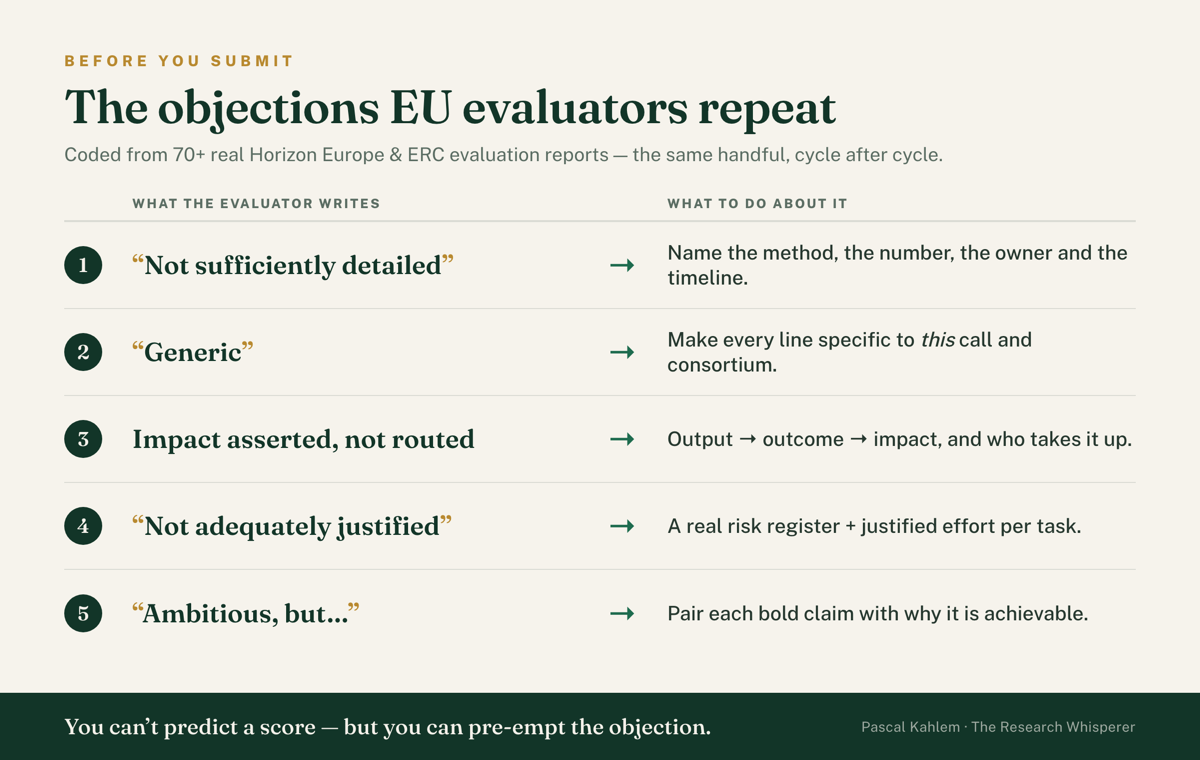
Here are the five objections I saw again and again, and what to do about each one:
1. “Not sufficiently detailed.” This is the most common comment by a wide margin, and it lands hardest on methodology, feasibility and risk. A sentence like “we will use established statistical methods to analyse the data” invites it, because it asserts without specifying. The fix is to trade assertions for specifics: name the method, the sample, the threshold, the person responsible and the point in the timeline. “Established statistical methods” becomes “mixed-effects models, powered for a 0.3 effect at n=120, run by WP3 in months 7–10.” Same claim, no gap to flag.
2. “Generic.” Evaluators write this when a passage could be lifted into any proposal in the call without changing a word. This criticism breeds in impact, dissemination and management sections. The test is quick and brutal: could a competitor submit your paragraph unchanged? If yes, it is generic. The fix is to make every sentence specific to this consortium, this call topic and this problem — the partner who will actually run the workshop, the named body that will actually use the result.
3. The impact pathway that isn’t there. Proposals routinely assert impact (“this will transform patient care”) without routing it through specifics. Evaluators are trained to look for the chain, so a claim with no pathway reads as a wish. Draw the chain explicitly: output → outcome → impact, and name who takes each step up. “A validated assay (output) adopted by three reference labs (outcome), shortening diagnosis by two weeks (impact), with uptake driven by our clinical partner.” The claim is the same; now it is credible.
4. Hand-wavy implementation. Work plans attract “not adequately justified” when effort, dependencies and risks are vague. Person-months appear without rationale; risks are listed as a formality, mitigated by “we will monitor closely.” Evaluators read the work plan to check that you have actually thought it through. A real risk register — likelihood, impact, a specific mitigation and an owner — plus a short justification for the effort on each task will answer most of this before it is asked.
5. Ambition the evidence doesn’t support. “Ambitious, but…” is a compliment with a knife in it. It means the reviewer wants to believe you and cannot. Bold objectives with no preliminary data, no track record and no feasibility argument read as over-claiming. You do not have to be less ambitious; you have to earn it. Pair every bold claim with the reason it is achievable: your pilot result, your prior grant, the equipment already in place.
Notice what these have in common. None is about being clever. They are about being specific, about closing the gap between what you know is true and what you have actually put on the page. Reviewers cannot give you credit for what is in your head.
A self-audit you can run the day before submission
Read your draft with one job: hunt your own vague words.
“Innovative”, “cutting-edge”, “state of the art”, “world-class”, “will ensure”, “robust”, “seamless”. Highlight every one. Those adjectives are precisely where an evaluator writes “generic” or “not substantiated”, because they claim a quality instead of demonstrating it.
Then, for each highlight, either delete it or replace it with the specific thing that makes it true. If “innovative” can’t be cashed out into what exactly is new and why it matters, it was decoration, and decoration is where scores leak. You cannot predict your score, and you should distrust anyone or any tool that says they can.
Panels are human and the competition is hidden. But the objections above are not hidden. They are the same handful, cycle after cycle, and every one of them is answerable while you still have time. The most valuable hour before you submit is the one you spend reading your own proposal the way an evaluator will: quickly, against a rubric, looking for the gap. Find it first, and close it.

Dr Pascal Kahlem is a professional European Union (EU) grant writer and reviewer who has worked on Horizon Europe and European Research Council (ERC) proposals from both sides — drafting them, and evaluating them. Through Scientific Network Management S.L. he has read and coded the criticism in 80 real European Union evaluation reports to learn what evaluators flag again and again. He is the author of The EU Grant Writer’s AI Playbook and the creator of Whetmark (whetmark.com), a private, self-hosted tool that surfaces likely evaluator objections on a draft before submission. He writes about grant craft for research teams across Europe.

